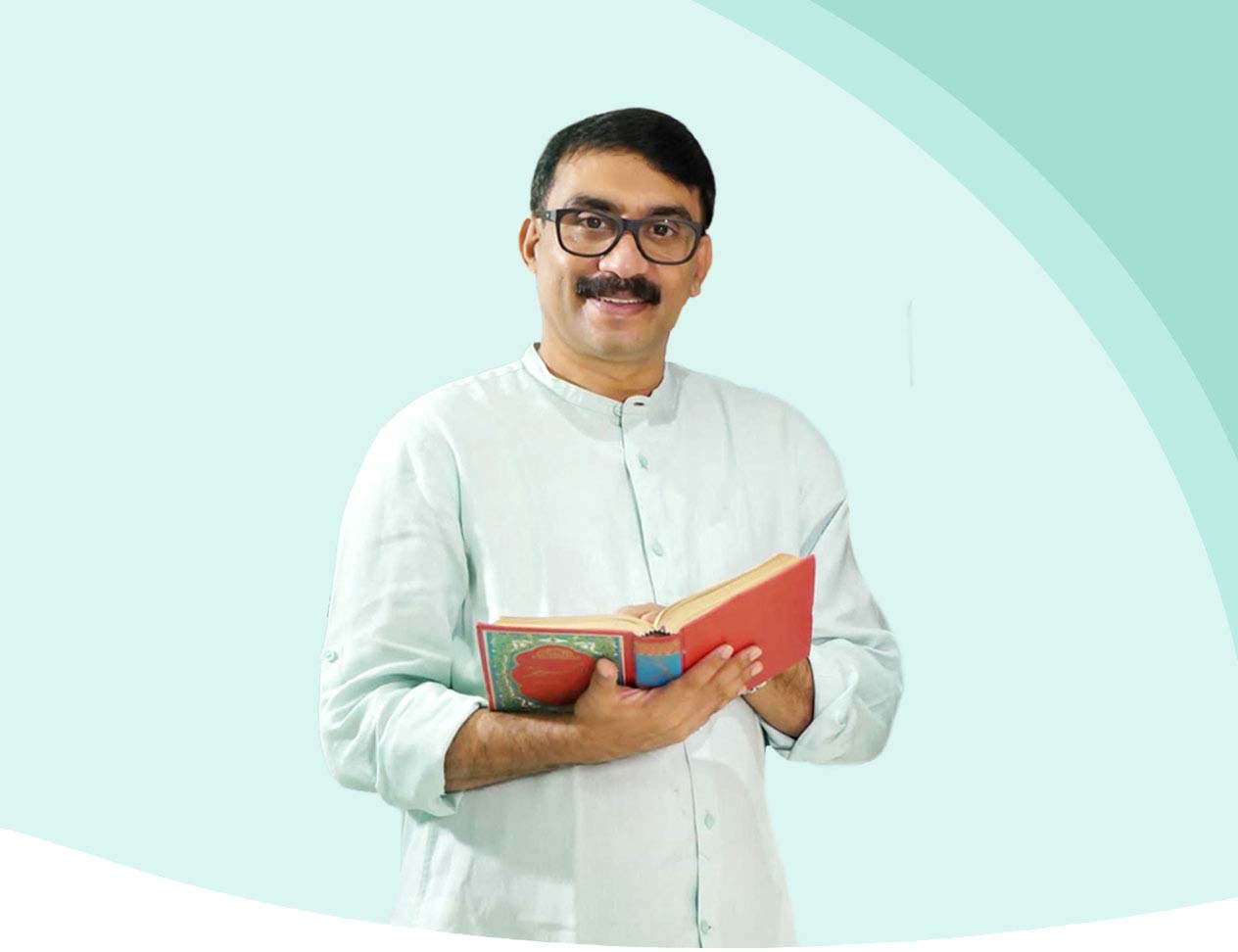
Hakim K. T. Ajmal is an internationally oriented Greeko–Arabic Integrative Medicine practitioner known for bridging classical healing traditions with contemporary wellness applications. His clinical practice centres on personalised herbal formulations, temperament based assessment, and root-cause correction systems designed to restore balance at a foundational level.
Grounded in Unani medicine, botanical therapeutics, and contemporary health understanding, Hakim Ajmal follows a holistic approach that treats the individual rather than isolated symptoms. His work reflects a strong scholarly lineage and deep clinical insight, emphasising a relational model of healing that recognises physical, emotional, environmental, and spiritual dimensions as interconnected aspects of wellbeing
Hakim Ajmal is sought after for his highly customised healing frameworks that offer clarity and long-term transformation. Through tailored regimens, guided interventions, and nature-based medicine, he supports individuals across the world in achieving sustainable health outcomes, positioning him as a trusted practitioner for those seeking integrative care and meaningful, lasting wellbeing.
Hakim K. T. Ajmal is a Unani physician, educator, and lifelong student of the science of healing. For more than three decades, his work has involved listening to the subtle language of the body, reading the pulse, observing what remains unspoken, and recognising that illness is rarely confined to the physical alone. More often, it reflects a deeper imbalance between how people live and who they are.
This booklet offers a glimpse into that journey. It is neither a formal textbook nor a personal travelogue. Instead, it is a space where traditional medical wisdom, contemporary realities, and lived human experience come together. The reflections within arise not from authority, but from continued learning and practice.
He writes not as an owner of healing, but as one shaped by it. If these pages help readers rediscover even briefly a sense of balance and awareness, they have served their purpose.
Hakim Ajmal does not travel to demonstrate what he knows, but to deepen his understanding of what remains unknown. Every place carries its own medicine, shaped by local plants, patterns of rest, and cultural relationships with pain, ageing, and loss. As a practitioner working across regions, his role is to approach these differences with respect, allowing medicine to relearn humility.
His work focuses on connection. He seeks to bridge Unani temperament science with indigenous and local healing knowledge, affirming that personalised care is essential rather than optional. He also aims to remind institutions that health cannot be reduced to procedures alone.
Hakim Ajmal welcomes collaboration with healers, academic institutions, communities, and healthcare systems. The intention is not to replace existing practices, but to work alongside them, asking how healing can become more thoughtful, responsive, and human—together.
Healing begins when a person feels genuinely seen, heard, and supported. Long before herbs, diagnoses, or prescriptions, there must be presence. Often, the most powerful form of medicine is the reassurance that one’s suffering is recognised and that it is not faced alone.
In Hakim Ajmal’s understanding, healing is not merely the absence of disease. It is the restoration of relationship. It reconnects body and inner life, behaviour and consequence, surroundings and internal state. While treatment may ease symptoms, healing reshapes the patterns from which those symptoms arise.
True medicine, therefore, is more than intervention. It is an invitation to return to balance and harmony.
Harmony-Based Medicine understands the body not as a collection of separate organs, but as a coordinated system of forces continually adjusting to remain in balance. In Unani medicine, this balance is shaped by Mizaj—the individual’s innate temperament—along with the interaction of humours, qualities, and elements.
When harmony is intact, the body is capable of correcting minor disturbances on its own. When harmony is disrupted, even modest stresses can develop into illness. This approach asks a broader question: which aspect of a person’s life has fallen out of alignment?
Sleep, digestion, mental state, relationships, environment, diet, and sense of purpose are examined not in isolation, but as interconnected influences within a single framework. From this perspective, healing is not about fighting disease, but about restoring coherence to a system that has lost its rhythm
At the heart of Unani thought lies a simple yet profound insight: life expresses itself through paired qualities. Hot and cold, moist and dry form the foundational axes through which the body’s landscape, the progression of illness, and the action of remedies can be understood.
Every organ, tissue, temperament, and even climate reflects a distinct combination of these opposing qualities. When heat becomes excessive, it may appear as inflammation, irritability, or agitation. When cold predominates, slowness, fatigue, and withdrawal often follow. Excess moisture can present as congestion or heaviness, while dryness may affect the skin, joints, and even emotional resilience.
The role of the healer is to interpret this balance of qualities, recognise where excess or deficiency exists, and support the body in returning gently toward equilibrium.
Mizaj, or temperament, is the defining signature of an individual. It shapes how the body responds to food, emotion, sleep, work, climate, and stress. Long before a condition receives a diagnostic label, a specific mizaj pattern is already at play.
When assessment is guided by temperament, the practitioner sees not only what has gone wrong, but why it has unfolded in that particular person. Viewing health through the lens of Mizaj allows care to be genuinely personalised.
An individual with a predominantly hot temperament may benefit from cooling foods, gentle routines, and calming environments, while someone with a cold, dry temperament may require warmth, oils, and deeply nourishing support. The same diagnosis cannot be applied or treated identically across both cases.
By honouring temperament, Mizaj safeguards individuality and prevents medicine from becoming a purely mechanical process.
The body is always communicating, and the healer’s responsibility is to learn how to listen. In traditional medical systems, diagnosis extends beyond instruments and reports. It includes pulse reading, observation of the face, tone of voice, posture, and even the quality of silence.
When Hakim Ajmal meets someone, he does not begin with a checklist of questions. He begins by observing how they arrive: the pace of movement, the way hands are held, the presence in the eyes. The pulse becomes a dialogue rather than a measurement. The face reflects internal climate, the skin carries history, and the voice reveals burden.
Through this comprehensive way of reading the person, treatment becomes not only more accurate, but also more intuitive and humane.
Food is the most frequent form of medicine people give themselves, taken several times each day. In the Unani perspective, every food carries its own temperament—warming, cooling, moistening, or drying. The stomach is not merely a vessel, but the first site of care.
A food-as-medicine approach aligns diet with individual temperament, season, age, and health condition. A person with a hot, dry nature living in a warm climate cannot be nourished in the same way as someone with a cold, moist temperament living in cooler regions.
When dietary choices are made with understanding, reliance on medication naturally lessens. When diet is overlooked, even the most carefully designed treatments struggle to create lasting improvement.
Plants carry a quiet intelligence. Each herb expresses its own character. Some are heating and dispersing, others cooling and stabilising. Some strengthen and build, while others cleanse and release.
In Unani practice, treatment rarely depends on a single herb. Instead, formulations are carefully composed to align with the patient’s temperament, the nature of the condition, and the intended direction of healing.
Customised formulation is both a discipline and an art, drawing on knowledge, clinical experience, and intuition. When these elements are properly aligned, healing unfolds gently yet profoundly, as if the body has been reminded of an order it has always recognized.
Prevention is not a slogan, but a disciplined way of living in alignment with one’s nature. In traditional systems, the most effective physician is often the one who helps illness never arise.
Lifestyle-based healing involves shaping daily rhythms that preserve harmony—sleep, timing of meals, movement, emotional balance, and spiritual orientation. Through this role, the healer also serves as an educator, guiding individuals to recognise early signs of imbalance before they become crisis.
There are forms of suffering that no laboratory test can capture and no scan can reveal. These belong to the inner lifepersonal narrative, meaning, and purpose.
In many healing traditions, including those shaped by Sufi thought, illness is sometimes understood not only as disruption, but also as teacher. Attending to the spiritual dimension of healing does not replace physical treatment; it deepens it.
Forgiveness can release physical tension. Gratitude can ease the breath. Prayer or remembrance can steady an anxious mind. Hakim Ajmal seeks to create space where medical treatment and inner faith exist together, each contributing to recovery.
Hakim Ajmal’s greatest teachers have always been his patients. He recalls cases where chronic pain eased only after emotional reconciliation, or migraines reduced once sleep aligned with natural rhythm.
These experiences have shaped his understanding that every case is a living story, not merely a diagnostic label. When people are approached as unfolding narratives rather than malfunctioning systems, medicine becomes more thoughtful and humane.
Through travel, Hakim Ajmal observes how each culture names imbalance and seeks wholeness in its own way—through herbs, touch, sound, or ritual. No single system holds the complete picture. Together, they form a living mosaic of healing knowledge.
His journey is guided by learning from this mosaic, listening to elders, healers, and practitioners, and identifying where traditions naturally complement one another. These questions shape the path more than any fixed destination.
Each place offers its own lesson. Some cultures teach simplicity, reminding us that less can be enough. Others teach patience, showing that time itself can be a form of medicine. Some emphasise community, ensuring that no one is left to suffer alone, while others embody courage in the face of uncertainty. When one travels with attention, every crossing becomes an opportunity to learn.
While languages differ and rituals take many forms, certain truths remain constant. People everywhere seek respect, feel relief when they are truly heard, find comfort in gentle human touch, and carry a deep desire for meaning. These shared needs affirm that healing belongs to humanity as a whole, not to any single tradition or profession.
Hakim K. T. Ajmal’s journey did not begin in airports, but in waiting rooms and quiet bedside conversations. Over years of clinical practice, he came to recognise that his work was drawing him beyond the boundaries of any single clinic or institution. Encounters with patients from varied walks of life, guidance from teachers across disciplines, and sustained inner inquiry gradually shaped a path toward global healing work.
Hermas Academia, Calicut Unani Hospital, and his teaching and clinical engagements represent important milestones along this path. They are not endpoints, but moments of learning within a longer journey whose intention is to extend temperament-based, humane, and integrated healing to broader communities. This booklet stands as another such milestone, marking a movement from local practice toward global dialogue and exchange.
Hermas Academia was established in response to a gap Hakim K. T. Ajmal encountered repeatedly in his work. He observed a growing distance between traditional medical wisdom and modern learners, between a rich textual heritage and its application in real clinical practice, and between philosophical understanding and everyday medicine. Hermas was created as a space where these dimensions could come together.
At the academy, the study of Mizaj science, herbal therapeutics, diagnostic arts, and lifestyle medicine is approached in a manner that remains faithful to tradition while engaging with present-day realities. Learners are encouraged to think, feel, and observe rather than simply memorise information. Hakim Ajmal’s hope is that Hermas serves as a guiding light for those seeking a deeper, more humane approach to medicine in an age that increasingly favours speed and mechanism over understanding.
In a world shaped by fragmented specialisation and accelerated care, Unani medicine offers a return to wholeness. It provides a structured understanding of temperament, a mature philosophy of balance, and a long-standing tradition of herbal, dietary, and lifestyle-based interventions. Rather than rejecting modern medical advances, Unani medicine seeks to ground them within a deeper and more coherent context.
One of Unani medicine’s greatest strengths lies in its commitment to personalisation. Two individuals carrying the same diagnostic label may receive entirely different forms of care, shaped by their mizaj, environment, and personal history. This respect for individuality is increasingly vital within global healthcare systems that often prioritise population-level protocols over personal experience. Through thoughtful dialogue with other medical traditions, Unani medicine can contribute meaningfully to the evolution of compassionate and integrative care.
Hakim K. T. Ajmal extends an invitation to healers, physicians, researchers, educators, and community leaders across the world to collaborate—through shared study, clinical exchange, dialogue, and integrative models of care that honour both scientific rigour and the human spirit.